Where to Go in September : Discover the Dordogne by Bike
In September, the Dordogne takes on a more peaceful atmosphere. The roads are less crowded, and the temperatures are more pleasant for exploring the region.
From Bordeaux to Sarlat, this route winds through several iconic landscapes and areas of the Southwest. Vineyards, medieval bastides, wooded valleys, rivers, and stone villages unfold one after another along the way. The route also offers a chance to discover a culture deeply rooted in its land.
This journey is a wonderful way to explore the Southwest in September, when the region returns to a more leisurely pace and is bathed in pleasant light.
From Bordeaux to Saint-Émilion: A Journey Through the Vineyards
Setting Out from the Wine Capital
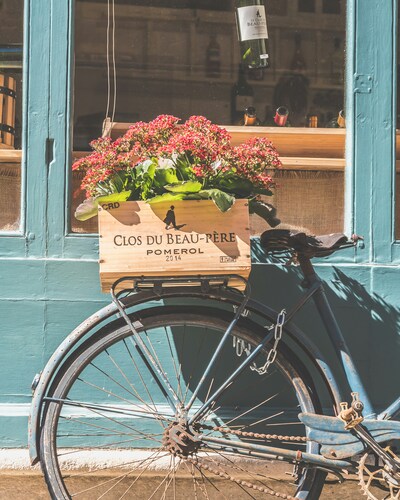
Bordeaux is an ideal starting point for this journey through southwestern France. From the historic center, the route crosses the Pont de Pierre bridge over the Garonne River before gradually leaving the city behind to reach the vineyard-dotted landscapes of the Entre-deux-Mers region. The route then follows the Roger Lapébie bike path, built on a former railroad track. As the kilometers pass, vineyards come into view, dotted with wineries where a tasting offers a chance to discover the great terroirs of the Gironde.
The route also passes through Créon, an English-style bastide founded in the 13th century. Beyond the vineyards, the countryside reveals a more understated heritage: Romanesque churches, abbeys, mills, and traditional villages dot the route.
elliot-paris
Saint-Émilion: The Elegance of a UNESCO-Designated Wine-Growing Heritage Site
Arriving in Saint-Émilion feels like stepping into a timeless world. Designated a UNESCO World Heritage Site, the village invites you to explore its cobblestone streets, pale stone facades, cave cellars, and stunning views of the vineyard-covered hillsides. After a day spent wandering through the vineyards, take the time to stroll through the village’s narrow streets and discover its heritage.
Don’t miss the bell tower of the monolithic church, which overlooks Saint-Émilion. Built in the 12th century and entirely carved out of limestone, this impressive underground church bears witness to the village’s unique history. From the bell tower, the view stretches over the rooftops of Saint-Émilion and the surrounding vineyards.
To end the day, there’s nothing more pleasant than settling down on a terrace with a glass of local wine and simply enjoying the peaceful atmosphere of the village.
From Sainte-Foy-la-Grande to Sarlat: Where History Meets Tradition
Sainte-Foy-la-Grande: One of the Oldest Bastides in Gironde
As you leave Saint-Émilion, the route gradually moves away from the major wine estates and into the more secluded landscapes of eastern Gironde. The journey winds through hillsides, vineyards, and orchards along small country roads dotted with villages whose heritage has been carefully preserved.
A stop in Castillon-la-Bataille offers a detour into history. It was here, in 1453, that the final battle of the Hundred Years’ War took place, marking the end of several decades of conflict between the French and English crowns. The landscape still bears the traces of this pivotal period in the region’s history.
The road then reaches the banks of the Dordogne and Sainte-Foy-la-Grande, a bastide founded in 1255. Its half-timbered houses, elegant arcades, and peaceful alleyways create a setting full of character. Its Saturday market is particularly renowned: a wonderful opportunity to discover local products in a friendly, down-to-earth atmosphere.
As you approach Bergerac, the landscape changes. The vineyards of Bordeaux gradually give way to greener countryside, signaling your entry into the Périgord.
Bergerac: Where Great Wine Regions Meet the Périgord Way of Life
From Sainte-Foy-la-Grande, the route winds through the landscapes of the Périgord, passing through vineyards, wooded hills, and small country roads. One stop in particular takes you to Monbazillac, perched on the heights of the Dordogne Valley. Its Renaissance château and renowned vineyards offer a first taste of the Bergerac wine region. A wine tasting at a vineyard offers the chance to discover Monbazillac’s famous sweet wine, which pairs particularly well with local specialties.
The route then descends gently toward Bergerac. For centuries, the river was used to transport local wines to Bordeaux and then on to major European ports. This commercial tradition played a major role in the city’s development.
Bergerac also has an unexpected literary side. Although the famous Cyrano de Bergerac never actually lived in the city, his name is associated with that of the poet and playwright Savinien de Cyrano de Bergerac, who later inspired Edmond Rostand.
In the historic center, the half-timbered houses, cobblestone streets, and the banks of the Dordogne invite you to take a stroll at the end of the day. Place Pélissière, lined with outdoor cafes and dominated by the Church of Saint-Jacques, is the perfect spot to wind down with a drink and discover another facet of the Périgord way of life.
Les Eyzies: From the Dordogne Valley to Prehistoric Lands

kbwills
Leaving Bergerac, the route follows the Lalinde Canal—converted into a greenway—past locks, mills, and lush green landscapes. You’ll then reach Lalinde, a former 13th-century English bastide, before continuing along the Dordogne River.
Gradually, the landscape changes: vineyards give way to oak forests and the limestone cliffs of the Périgord Noir. Some of these cliffs still harbor troglodytic dwellings, carved directly into the rock, evidence of a way of life once perfectly adapted to the valley’s terrain.
Your arrival in Les Eyzies, the world capital of prehistory, marks a new cultural milestone. It was here that the Cro-Magnon Man was discovered in 1868. Caves, rock shelters, and archaeological sites bear witness to a human presence dating back tens of thousands of years.
Montignac – Sarlat: From Lascaux to the Heart of the Périgord Noir
This final leg of the route winds through the Vézère Valley to Montignac, where Lascaux—one of the world’s most famous prehistoric sites—awaits you.
The story of its discovery is almost as fascinating as its paintings. In September 1940, four teenagers were exploring the area with their dog, Robot, when he disappeared into a hole after chasing a rabbit. Upon widening the opening, they discovered the entrance to the cave and its paintings, which date back more than 17,000 years.
Today, Lascaux IV offers a faithful reproduction of the original cave, complete with its depictions of horses, bison, and deer. After this cultural stop, the route continues toward Sarlat-la-Canéda, through the landscapes of the Périgord Noir.
The arrival in the remarkably well-preserved old town brings the journey to a close, winding through cobblestone alleys lined with pale stone houses and stately mansions. To round out this journey, a delicious Périgord meal is a must, featuring the region’s iconic products: truffles, walnuts, foie gras, and local wines.

Marlene Vicente
From Bordeaux to Sarlat: a route worth extending
Arriving in Sarlat doesn’t necessarily mean the end of the journey. You can extend your itinerary to La Roque-Gageac, Beynac-et-Cazenac, or Domme before heading to Souillac. Further east, Rocamadour stands out as a remarkable final stop: its medieval town, built on the side of a cliff, overlooks the Alzou Valley and is home to a cluster of historic sanctuaries.
This extension offers a different perspective on the journey. After the prestigious Bordeaux vineyards and the heritage of the Périgord Noir, the route gradually makes its way into the Lot region, with its more rugged landscapes and charming villages.
From Bordeaux to Rocamadour, the route thus offers an elegant journey through the Southwest, where heritage, landscapes, and the art of living unfold as you travel.