Exploring the D-Day Beaches by Bike: A Getaway in Normandy, Where History Meets the Sea
Peter.H
Exploring the D-Day beaches by bike is a unique way to experience Normandy. From Caen to Bayeux, every pedal stroke takes you through nine centuries of history, from William the Conqueror to the soldiers of June 6, 1944.
Here, the light is constantly changing, and the wind blows in from the sea. The roads wind their way between the hedgerows of the bocage and the cliffs battered by the sea. Cycling then becomes a way to listen to the surroundings. It gives silence time to settle in, then carries you to a small harbor filled with the scent of the sea.
Five days are all it takes to experience this journey. First, you’ll visit the major historical sites. Next, you’ll get a taste of the Norman way of life. Finally, you’ll come to understand what books only tell half the story about.
1 . Caen, the starting point for a bike tour of the D-Day beaches
It all begins in Caen, a two-hour train ride from Paris. The city still bears the mark of William the Conqueror. Its ducal castle towers over the city center. Furthermore, the two abbeys he founded with Queen Matilda stand facing each other at opposite ends of the city.
The Peace Memorial: An Essential First Step
Welcome to Caen, the vibrant capital of Lower Normandy, easily accessible by train. Your cycling adventure in Normandy begins here. You’re in the heart of a region rich in history and heritage. Once the city of William the Conqueror, Caen is home to a wealth of medieval treasures: the majestic Ducal Castle, the Abbaye aux Hommes, and the Abbaye aux Dames. Before hitting the road, be sure to visit the Caen Memorial. This museum chronicles the 20th century with remarkable accuracy. It provides you with the keys to understanding everything that awaits you along the coast.

2 . Along the canal, all the way to Pegasus Bridge
From downtown Caen, a greenway follows the canal all the way to the sea. No cars, hardly any hills: just the water, the trees, and the birdsong.
Very quickly, the city fades from view and the landscape opens up to the wetlands of the Orne. As we ride along the river, we pass fishermen who’ve been there since dawn, early morning walkers, and occasionally a sailboat heading back toward the port of Caen. The pace naturally slows down, and you take the time to adjust your saddle, get comfortable on your bike, and catch your breath. It’s also the perfect time to warm up before the excitement of the coming days. So, without effort or stress, you gradually glide along.And so, effortlessly and without stress, we gradually drift from the city into history.
Pegasus Bridge: Where It All Begins

Tatanovitch
At the end of this quiet stretch of road stands Pegasus Bridge. Shortly after midnight on June 6, 1944, British gliders landed here in the dark. Within minutes, the soldiers had taken the bridge. D-Day had just begun. Right next door, Café Gondrée claims to be the first building in France to be liberated. It’s therefore the perfect spot for a break that feels like stepping back in time.
Merville: Between the Beach and History
Next, the route follows the Orne River to Merville-Franceville, where you’ll have lunch overlooking the beach. In the afternoon, the Merville Battery immerses you in the paratroopers’ assault, right down to the cockpit of a bomber. Finally, the same greenway takes you back to Caen in the evening light.
Evening Out: A Charming Hotel and Norman Cuisine
Finally, in the soft light of late afternoon, you head back to your lodging for the night. Upon arrival, your hotel is ready to welcome you, and your luggage is already in your room. Chosen for its comfort and charm, it offers the perfect setting to unwind after a day of activity. A hot shower, a moment of rest—and your appetite is whetted.
Because when evening comes, it’s time for Norman cuisine. Foodies will want to try one of the region’s great specialties: Caen-style tripe, simmered for hours in cider. Others may prefer mussels in cream sauce or a Norman sole, topped with a rich sauce. Next, the cheese platter is a must: Camembert, Pont-l’Évêque, and Livarot—the region’s three most famous cheeses. For dessert, treat yourself to a Norman apple tart or teurgoule, a cinnamon-spiced rice pudding slowly baked in the oven. Finally, a glass of cider, pommeau, or calvados is the perfect accompaniment to this meal. It’s just what you need to recharge your batteries before exploring the coast and its historic sites tomorrow.

AfricaImages
3 . Exploring the D-Day Beaches by Bike, from Juno Beach to Arromanches
The next day, we headed for the coast. First, small country roads led to the Canadian cemetery in Reviers, a quiet place of reflection. Then the horizon opened up to reveal the sea: here is Juno Beach, in Courseulles-sur-Mer, where the Canadians landed. Its visitor center sensitively recounts the commitment of an entire country.
Next, you’ll join the Vélomaritime, the major bike route that runs along the English Channel. From the port of Courseulles, quiet country roads lead you first to Ver-sur-Mer. There, a dedicated bike path begins, winding its way between the marshes and the sea. The landscape opens up, birds take flight from the reeds, and the wind carries the scent of the sea. In Asnelles, a gourmet stop is a must: the famous Asnelles shortbread cookies, made with pure butter, are a welcome addition to your bag. Finally, the trail climbs gently toward the heights and suddenly reveals a spectacular view of Arromanches Bay. These fifteen kilometers are among the most beautiful of the entire trip.
Arromanches, a highlight of the D-Day beaches bike tour

A steep descent—which should be approached with caution—leads you to the heart of Arromanches-les-Bains. Out at sea, you can still see the remains of the artificial harbor that the Allies assembled in England and then towed across the English Channel. In addition, the Arromanches 360 circular cinema deepens the emotional experience with its archival footage.
In the late afternoon, the bocage landscape leads you to Bayeux, where your hotel awaits you.
Alternative Route: The Côte de Nacre via Sword Beach
If you enjoy long distances, opt for the 65-km route, which runs entirely along the coast. First thing in the morning, you’ll pass by Pegasus Bridge again, then head to the port of Ouistreham, where ferries depart for England. Right next to it lies Sword Beach, where Major Kieffer’s French commandos landed. From there, the route follows the Côte de Nacre and its seaside resorts: Lion-sur-Mer, Luc-sur-Mer, and Saint-Aubin-sur-Mer. Their Belle Époque villas and seaside promenades offer lovely spots to take a break while gazing out at the waves. You’ll reach Juno Beach along the coast before continuing on to Arromanches, with the sea spray as a bonus. This route requires a bit more stamina, but it offers a complete immersion in the landscapes of the D-Day landings.
4 . Omaha Beach, the beating heart of the trip
It’s a day you’ll never forget. It begins at the American Cemetery in Colleville-sur-Mer. More than 9,000 white graves stand in rows facing the sea. We walk slowly, without saying a word.
Omaha Beach and the Overlord Museum

Just below lies Omaha Beach, the deadliest beach of D-Day. Today, however, the sandy shore is vast and peaceful. Walk down to the water’s edge, then turn back toward the hills. At a glance, you can appreciate the ordeal the soldiers endured. Nearby, the Overlord Museum rounds out the visit.
Since July 26, 2026, the D-Day beaches have been listed on the UNESCO World Heritage List under the name “The D-Day Beaches, Normandy 1944.” This designation marks the culmination of nearly twenty years of efforts. It protects approximately 80 kilometers of coastline: the five historic beaches, as well as Pointe du Hoc and the artificial harbor at Arromanches. In other words, nearly every stage of this journey now passes through a designated historic site. Thus, cycling here means traveling through one of the most meaningful landscapes in the world, recognized for its universal values of peace and freedom. To continue your exploration, check out our ideas for cycling trips through UNESCO heritage sites.
Pointe du Hoc, the most striking of the D-Day beaches to explore by bike

Descending toward Seyssel, a riverside town, ViaRhôna crosses a gentler valley. The village, dominated by the old suspension bridge and surrounding hills, offers a fine example of medieval heritage. History lovers can stop to admire the old castle and stroll along the rehabilitated riverbanks, where viewpoints over the river reveal terraced vineyards and steep slopes characteristic of this part of Savoie and Ain.
Further south, ViaRhôna leads to Lyon, a major historic metropolis listed as a UNESCO World Heritage site. Here, the contrast between nature and urban life is striking. The Rhône riverbanks, recently redeveloped for cyclists and pedestrians, offer peaceful promenades in the heart of the city. Cyclists can explore Vieux Lyon, a Renaissance district with cobbled streets and secret traboules, the ancient Roman theater of Fourvière, and enjoy local gastronomy in the famous “bouchons lyonnais.” The river becomes a guiding thread between history, culture, and modernity.
Port-en-Bessin: A Gourmet Break
Finally, it’s time to catch our breath. Port-en-Bessin, a small fishing port with colorful boats, offers the perfect stop after an exciting morning. Here, life still revolves around the sea: trawlers return to port, crates of fish are auctioned off, and seagulls circle above the docks. From the hilltop, the Vauban Tower has watched over the harbor since the late 17th century. The port is also one of Normandy’s top destinations for scallops. In season, from October through May, you can enjoy them fresh off the boat, simply sautéed in butter or topped with Normandy cream. The rest of the year, mussels, oysters, and the catch of the day are just as delicious. Then, rested and satisfied, you’ll head back toward Bayeux through the countryside, your mind filled with memories.
5. Bayeux: The Epilogue
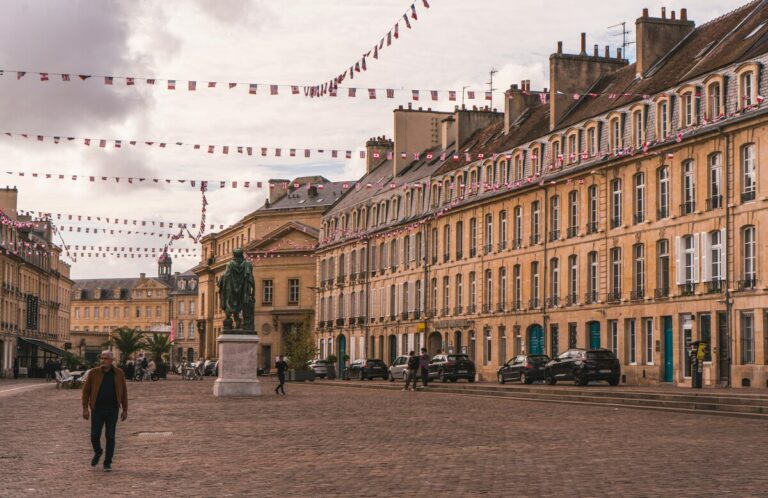
Liberated on June 7, 1944, the day after D-Day, Bayeux emerged from the war almost unscathed. This is a rare stroke of luck in Normandy, and you can feel it on every street corner. Here, you can stroll among half-timbered houses, stone mansions, and cobblestone alleys. Along the Aure River, old water mills serve as a reminder of the town’s artisanal past. On Saturday mornings, the market brings the town center to life with its cheeses, cider, and seafood.
At the end of the road stands Notre-Dame Cathedral, a masterpiece of Norman Romanesque and Gothic art. It was consecrated in 1077 in the presence of William the Conqueror himself. Its slender spires can be seen from afar, long before you enter the city: a perfect landmark to mark the end of the bike ride.
Bayeux, a City of Remembrance
Bayeux also holds a special place in the history of the Liberation. It was here that General de Gaulle delivered his first speech on liberated French soil on June 14, 1944. In addition, the Battle of Normandy Memorial Museum chronicles the long weeks of fighting that followed D-Day. Directly across from it, the British military cemetery—the largest Commonwealth cemetery in France for World War II—invites visitors to reflect. Finally, the Mémorial des Reporters pays tribute to journalists killed in the line of duty since 1944.
Bayeux is home to its famous Tapestry, which is actually a wool embroidery on linen. About 70 meters long, it depicts the conquest of England by William in 1066, up to the Battle of Hastings. Ships, horses, banquets, and battles unfold one after another, much like in a medieval comic strip. Its significance is such that UNESCO has inscribed it on the “Memory of the World” Register. And so, the journey comes to a close with a charming twist of history: two crossings of the English Channel, nine centuries apart, in opposite directions.
Good to know: The Tapestry Museum remains closed for renovations. The tapestry is on display at the British Museum in London through July 11, 2027—its first time outside of France. It will then return to Bayeux in the fall of 2027, in a completely redesigned museum. Until then, the town remains a fascinating destination, and the reopening will be a wonderful opportunity to visit again.

Wolfblur
How about taking a trip?
We’ve just returned from Normandy with our minds full of images: the white graves, the wind blowing across the dunes, the evening light on the docks at Port-en-Bessin. And we’ve also come back a little changed. Because cycling along these beaches is a way of paying tribute, in our own way, to those who once walked them.
To explore the D-Day beaches by bike at your own pace, check out our five-day tour from Caen to Bayeux. And if you’d like to add an extra night or take a detour to Mont-Saint-Michel, we’ll create a custom trip just for you.